
When organizations outgrow single-machine analytics, Apache Spark is where they land. PySpark — the Python interface to Apache Spark — has become the de facto standard for distributed data processing across industries ranging from financial services to healthcare to telecommunications. It is not simply popular; it is entrenched. Understanding why PySpark achieved this dominance, and what makes it the right target platform for modernization projects, is essential for any enterprise planning a migration from legacy analytics.
This article examines the technical foundations that make PySpark the enterprise standard, from the Catalyst optimizer to adaptive query execution, and from YARN clusters to Kubernetes-native deployments.
Why PySpark Dominates Enterprise Data Engineering
PySpark's dominance is not accidental. It emerged from a decade of engineering investment by the Apache Software Foundation community, thousands of contributors, and battle-testing across the largest data platforms on the planet. Several factors explain its position.
Unified processing model. Spark handles batch processing, stream processing, SQL analytics, machine learning, and graph computation through a single engine. Before Spark, enterprises ran separate systems for each workload — Hadoop MapReduce for batch, Storm for streaming, Hive for SQL, Mahout for ML. PySpark consolidates these into one API, one optimizer, and one cluster. This unification dramatically reduces operational complexity.
Python-first ecosystem. While Spark was originally written in Scala, PySpark has become the dominant interface. Over 70% of Spark workloads now run through PySpark. The Python data science ecosystem — pandas, scikit-learn, NumPy, matplotlib — integrates natively with PySpark through UDFs, pandas UDFs (Arrow-optimized), and the pandas API on Spark. Data engineers and data scientists work in the same language, on the same cluster, with the same data.
Massive community and ecosystem. Apache Spark has over 1,800 contributors and is maintained by a foundation, not a single vendor. This means long-term stability, transparent governance, and no vendor lock-in. Libraries like Delta Lake, Apache Iceberg, and Apache Hudi extend Spark with ACID transactions and lakehouse capabilities. Connectors exist for virtually every data source — JDBC databases, cloud storage (S3, GCS, ADLS), Kafka, Elasticsearch, and hundreds more.

Apache PySpark — enterprise migration powered by MigryX
The Catalyst Optimizer: SQL-Grade Query Planning
At the heart of Spark's performance is the Catalyst optimizer, a query planning engine that transforms logical operations into optimized physical execution plans. When you write PySpark code, you are not writing execution instructions — you are declaring intent. Catalyst decides how to execute it efficiently.
The optimization pipeline works in four phases:
- Analysis — resolves column references, validates table schemas, and binds functions to their implementations.
- Logical optimization — applies rule-based transformations such as predicate pushdown, column pruning, constant folding, and filter reordering.
- Physical planning — generates candidate physical plans (e.g., sort-merge join vs. broadcast hash join) and selects the lowest-cost option using statistics.
- Code generation — produces optimized JVM bytecode using Tungsten's whole-stage code generation, eliminating virtual function calls and leveraging CPU cache locality.
from pyspark.sql import SparkSession
from pyspark.sql.functions import col, sum as spark_sum, count

spark = SparkSession.builder \
    .appName("CatalystDemo") \
    .getOrCreate()

# Catalyst optimizes this entire chain as a single plan
result = (
    spark.read.parquet("s3a://data-lake/transactions/")
    .filter(col("transaction_date") >= "2025-01-01")
    .filter(col("region") == "APAC")
    .groupBy("product_category")
    .agg(
        spark_sum("amount").alias("total_revenue"),
        count("transaction_id").alias("transaction_count")
    )
    .orderBy(col("total_revenue").desc())
)

# View the optimized physical plan
result.explain(mode="formatted")
Catalyst will automatically combine the two .filter() calls, push them before any shuffle operations, prune unused columns from the Parquet read, and select the optimal join strategy if additional tables are involved. This optimizer is what makes PySpark competitive with hand-tuned SQL queries on traditional databases.
MigryX: Idiomatic Code, Not Line-by-Line Translation
The difference between MigryX and manual migration is not just speed — it is code quality. MigryX generates idiomatic, platform-optimized code that leverages native features of your target platform. A SAS DATA step does not become a clunky row-by-row loop — it becomes a clean, vectorized DataFrame operation. A PROC SQL query does not become a literal translation — it becomes an optimized query that takes advantage of your platform’s pushdown capabilities.
Adaptive Query Execution
Spark 3.0 introduced Adaptive Query Execution (AQE), which re-optimizes query plans at runtime based on actual data statistics rather than relying solely on pre-execution estimates. This addresses a fundamental limitation of static optimization: the optimizer's pre-execution statistics are often stale or inaccurate, especially for complex multi-stage queries.
AQE provides three key capabilities:
- Dynamic partition coalescing — after a shuffle, AQE examines actual partition sizes and merges small partitions to reduce task overhead. If a shuffle produces 200 partitions but most are tiny, AQE coalesces them into a smaller number of balanced partitions.
- Dynamic join strategy switching — if AQE discovers that one side of a sort-merge join is actually small enough for a broadcast, it switches strategies mid-execution. This can eliminate expensive shuffle operations entirely.
- Skew join optimization — data skew causes a few partitions to be orders of magnitude larger than others, creating stragglers that dominate execution time. AQE detects skewed partitions and splits them into smaller sub-partitions for parallel processing.
# Enable AQE in your Spark session
spark.conf.set("spark.sql.adaptive.enabled", "true")
spark.conf.set("spark.sql.adaptive.coalescePartitions.enabled", "true")
spark.conf.set("spark.sql.adaptive.skewJoin.enabled", "true")

# AQE automatically optimizes this join at runtime
orders = spark.read.parquet("s3a://lake/orders/")
customers = spark.read.parquet("s3a://lake/customers/")

joined = orders.join(customers, "customer_id", "inner")
result = joined.groupBy("segment").agg(spark_sum("total").alias("revenue"))
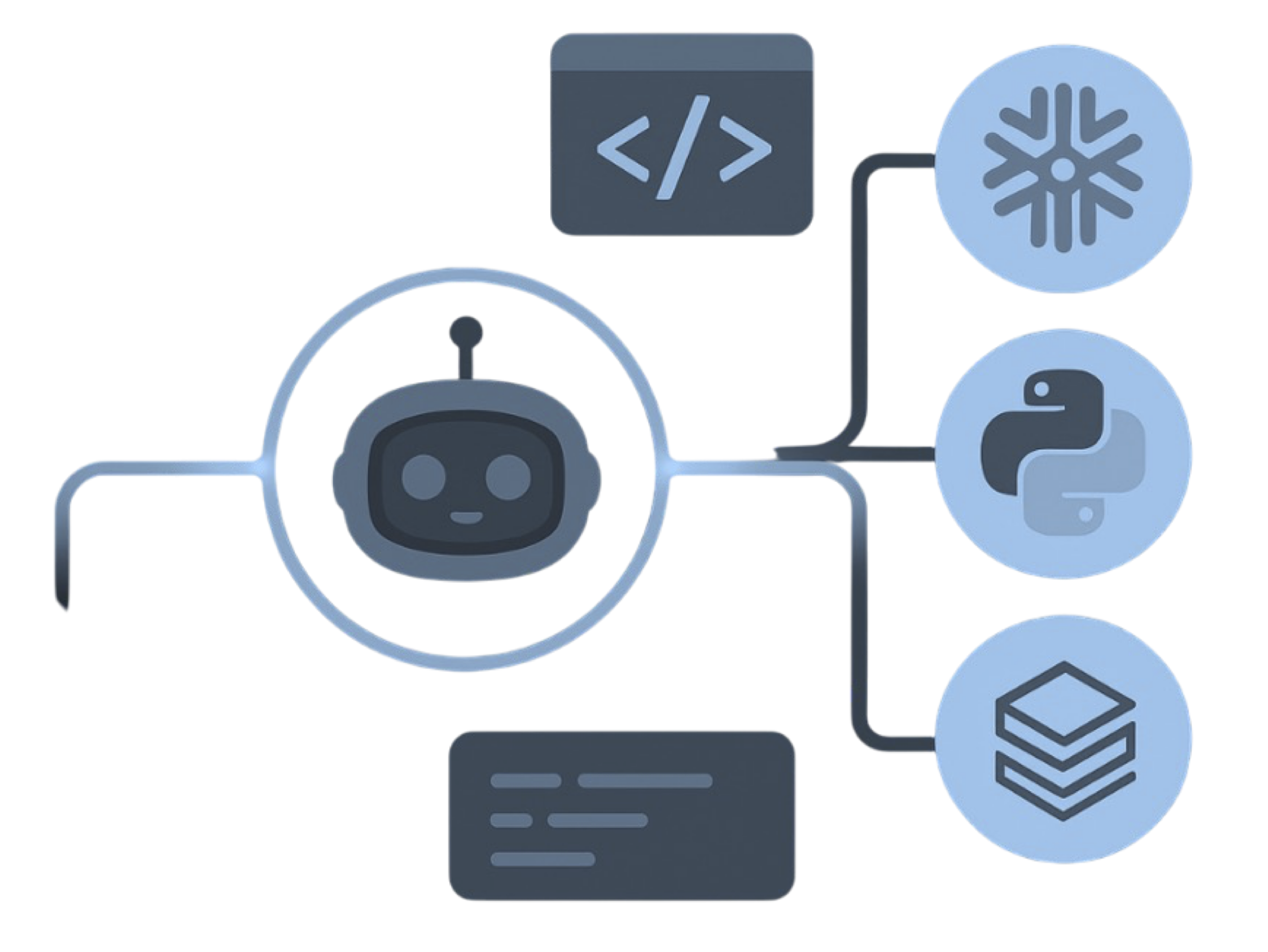
MigryX precision parser — Deep AST-level analysis ensures every construct is understood before conversion begins
Platform-Specific Optimization by MigryX
MigryX maintains deep knowledge of every target platform’s strengths and best practices. When converting to Snowflake, it leverages Snowpark and native SQL functions. When targeting Databricks, it uses PySpark DataFrame operations optimized for distributed execution. When generating dbt models, it follows dbt best practices for modularity and testability. This platform awareness is what makes MigryX output production-ready from day one.
Deployment: YARN, Kubernetes, and Standalone
PySpark's flexibility extends to deployment. Unlike tools that require a specific infrastructure, Spark runs on multiple cluster managers, giving enterprises the freedom to choose based on their existing infrastructure.
| Cluster Manager | Best For | Key Characteristics |
|---|---|---|
| YARN | Hadoop-native environments | Mature resource management, data locality with HDFS, established security (Kerberos) |
| Kubernetes | Cloud-native and containerized deployments | Dynamic scaling, pod-level isolation, multi-tenant clusters, cost optimization via spot instances |
| Standalone | Development, testing, small clusters | Zero dependencies, simple setup, full Spark functionality |
| Apache Mesos | Mixed-workload clusters (legacy) | Fine-grained resource sharing across Spark and non-Spark workloads |
Kubernetes has emerged as the fastest-growing deployment mode. Spark 3.x introduced native Kubernetes support with dynamic resource allocation, pod templates for custom configurations, and node selectors for GPU and spot instance scheduling. For cloud deployments, this means submitting PySpark jobs directly to a Kubernetes cluster on AWS EKS, Google GKE, or Azure AKS without managing a dedicated Hadoop cluster.
# Submit a PySpark job to Kubernetes
spark-submit \
  --master k8s://https://k8s-api-server:6443 \
  --deploy-mode cluster \
  --name etl-pipeline \
  --conf spark.kubernetes.container.image=company/spark:3.5 \
  --conf spark.kubernetes.namespace=data-engineering \
  --conf spark.executor.instances=10 \
  --conf spark.executor.memory=8g \
  --conf spark.executor.cores=4 \
  s3a://code-bucket/etl_pipeline.py
Ecosystem Maturity and Integration
PySpark's ecosystem is unmatched in the distributed processing space. The integrations that matter most for enterprise migrations include:
- Delta Lake / Apache Iceberg — ACID transactions, time travel, schema evolution, and upsert (MERGE) support on top of cloud storage. These lakehouse formats turn your data lake into a reliable, versioned data platform.
- Structured Streaming — process real-time data with the same DataFrame API used for batch, with exactly-once guarantees and support for Kafka, Kinesis, and Event Hubs.
- MLlib — distributed machine learning with scalable implementations of classification, regression, clustering, and recommendation algorithms, plus pipeline APIs for feature engineering.
- Spark Connect (3.4+) — a thin client protocol that decouples the PySpark client from the Spark cluster, enabling remote connectivity, better resource isolation, and easier upgrades.
Key Takeaways
- PySpark is the most widely deployed distributed data processing framework, with over a decade of enterprise hardening.
- The Catalyst optimizer and Adaptive Query Execution deliver SQL-grade performance without manual tuning.
- Kubernetes-native deployment enables elastic, cloud-native Spark clusters without Hadoop dependencies.
- The open-source ecosystem (Delta Lake, Iceberg, Structured Streaming, MLlib) provides a complete data platform.
- MigryX automates the conversion of legacy SAS, Informatica, and DataStage pipelines to production-ready PySpark code.
PySpark is not merely a tool; it is the platform on which modern data engineering is built. For organizations migrating from legacy systems — SAS, Informatica, DataStage, SSIS — PySpark provides the scale, performance, and ecosystem depth needed to consolidate fragmented analytics infrastructure into a single, modern platform. The question is not whether to adopt PySpark, but how quickly your team can get there.
Why MigryX Delivers Superior Migration Results
The challenges described throughout this article are exactly what MigryX was built to solve. Here is how MigryX transforms this process:
- Production-ready output: MigryX generates code that passes code review and runs in production — not prototype-quality output that needs weeks of cleanup.
- Platform optimization: Converted code leverages target platform-specific features for maximum performance and cost efficiency.
- 25+ source technologies: Whether migrating from SAS, Informatica, DataStage, SSIS, or any of 25+ legacy technologies, MigryX handles it.
- Automated documentation: Every conversion decision is documented with before/after code mappings and transformation rationale.
MigryX combines precision AST parsing with Merlin AI to deliver 99% accurate, production-ready migration — turning what used to be a multi-year manual effort into a streamlined, validated process. See it in action.
Ready to migrate to PySpark?
See how MigryX converts legacy analytics pipelines to production-ready PySpark code at scale.
Explore PySpark Migration Schedule a Demo