Enterprise data teams know where they want to be: modern, SQL-first transformation pipelines running in dbt, with version control, automated testing, and self-generating documentation. The challenge is not the destination — it is the sheer scale of what must be converted to get there. This article explains how MigryX automates the conversion of thousands of legacy programs into production-ready dbt projects, turning what would be a multi-year manual effort into a structured, accelerated migration.
The Scale Challenge
Enterprise migration is not converting 10 SAS programs to dbt. It is converting 5,000+ SAS programs, 2,000 Informatica mappings, and 800 DataStage jobs — all interconnected, all undocumented, all running in production every night. The dependencies between these assets are complex and implicit: a SAS macro library shared across 200 programs, an Informatica mapping that feeds a DataStage job that feeds a SAS reporting script.
Manual rewrite at this scale takes years and costs millions. A senior engineer can realistically convert and test 3-5 complex programs per week. At 5,000 programs, that is 1,000 engineer-weeks — roughly 20 engineer-years of effort. Factor in project management, testing, and deployment, and the timeline stretches to 3-5 years with a team of 10-15 engineers.
During that timeline, the legacy environment must continue running. The organization pays SAS licensing fees, maintains legacy infrastructure, and manages two parallel platforms. Every month of delay compounds the cost. Every quarter of parallel operation erodes the business case.
This is the problem MigryX was built to solve. Not by eliminating engineering judgment, but by automating the deterministic, pattern-based translation work that consumes 70-80% of manual migration effort, freeing engineers to focus on architecture decisions, edge cases, and optimization.

dbt — enterprise migration powered by MigryX
MigryX's Approach: Parse, Analyze, Convert, Validate
MigryX processes legacy code through four distinct stages, each building on the output of the previous one.
MigryX deeply analyzes legacy code across all supported source platforms, understands every construct and dependency, then generates production-ready dbt projects.
The analysis stage produces dependency graphs, complexity scores per asset, and recommended migration wave groupings. The conversion stage generates appropriate dbt constructs for every source artifact — models, macros, sources, tests, and documentation. The validation stage automatically compares legacy output to dbt output, producing pass/fail reports for every converted asset.
Merlin AI: Beyond Pattern Matching
Most migration tools rely on rule-based pattern matching — if they see PROC SORT, they emit ORDER BY. Merlin AI goes deeper. It understands the semantic intent of code: why a particular sort order matters for a downstream merge, why a seemingly redundant WHERE clause is actually a business rule, why a macro parameter has an unusual default. This contextual understanding is what elevates MigryX’s accuracy from 95% (already industry-leading with deterministic AST parsing) to 99%.
Auto-Generated dbt Project Structure
MigryX does not produce a flat directory of SQL files. It generates a complete dbt project that follows community best practices and is ready for dbt build from day one.
MigryX generates a complete, well-organized dbt project following the staging/intermediate/marts convention, with all models, macros, tests, and documentation in place.
The generated dbt_project.yml includes proper materialization strategies, custom schema routing, and variable definitions tailored to the specific migration. These defaults can be overridden per model, but the generated configuration provides a production-ready starting point.
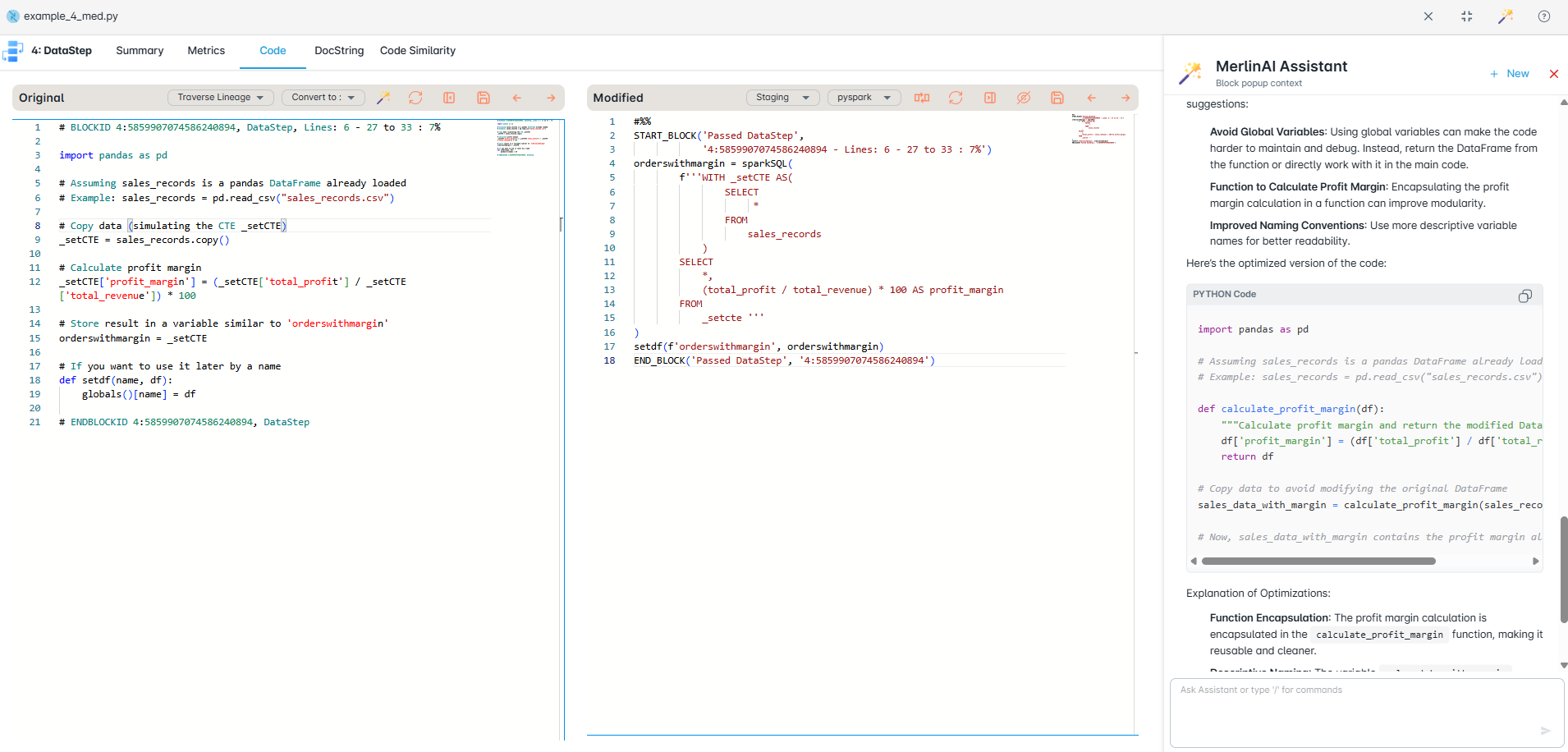
MigryX AI Optimization refactors converted code for peak performance on your target platform
AI That Learns Your Entire Codebase
Merlin AI does not just translate code in isolation. It builds a contextual model of your entire codebase — understanding how programs relate to each other, how macros are used across teams, and how data flows through your enterprise. This holistic understanding means MigryX resolves ambiguities that would stump any tool looking at one program at a time.
Macro Translation Engine
Macro systems are the hardest part of any legacy migration. SAS macros, Informatica reusable transformations, and DataStage shared containers all serve the same purpose — encapsulating reusable logic with parameters — but each uses a different syntax and execution model.
MigryX translates the full spectrum of macro patterns — from simple variable substitution to deeply nested conditional code generation — into idiomatic Jinja macros.
The resulting Jinja macros are readable, well-documented, and follow dbt community conventions — including docstring comments, consistent naming, and clear parameter documentation. Engineers reviewing the output can understand and extend the macros without reverse-engineering the original SAS logic.
Test Generation & Lineage Preservation
Automated test generation is one of MigryX's most impactful capabilities. For every converted model, MigryX analyzes the source code and metadata to generate appropriate dbt tests:
- Unique tests on columns identified as primary keys (detected from SAS indexes, Informatica key definitions, or DataStage key columns).
- Not_null tests on columns that are required in the source schema or that are used in join conditions (a null key would silently drop rows).
- Accepted_values tests on columns with known enumerated values (detected from SAS format catalogs, Informatica lookup transformations, or DataStage reference constraints).
- Relationship tests for foreign key references between models, ensuring referential integrity across the dbt project.
- Custom SQL tests for complex business rules extracted from SAS validation scripts, Informatica post-session validation, or DataStage quality stage logic.
These tests are not generic boilerplate. They are derived from the specific validation logic in the legacy code, ensuring that the dbt project enforces the same data quality rules that the legacy platform did — plus additional tests that dbt makes easy to add.
End-to-End Quality
MigryX does not just convert code — it converts quality gates. Every validation rule, data check, and business constraint in the legacy system is translated into dbt tests that run automatically on every pipeline execution. The result is a dbt project that is more rigorously tested than the legacy system it replaces.
Column-level lineage is preserved throughout the conversion. MigryX tracks how each source column flows through transformations to output columns, and embeds this lineage metadata in dbt model descriptions and column descriptions. When engineers run dbt docs generate, the resulting documentation site includes complete lineage information from day one — no manual documentation required.
Enterprise Deployment Patterns
Not every organization migrates the same way. MigryX supports three deployment patterns, each suited to different organizational constraints and risk tolerances.
Pattern 1: Full Migration
All legacy assets are converted to dbt in a single program. This pattern is appropriate when the legacy platform's license renewal is approaching, when the codebase is well-understood and moderately sized, or when the organization has committed budget and engineering capacity for a focused effort. MigryX converts the entire codebase, validates all output, and the organization cuts over from legacy to dbt in a planned transition window.
Pattern 2: Phased Migration
Legacy assets are converted in dependency-aware waves, with legacy and dbt running in parallel during the transition period. Wave 1 might include the foundational staging models and high-value mart pipelines. Wave 2 adds intermediate models and secondary pipelines. Each wave is validated independently before the next begins. This pattern reduces risk by allowing the organization to build confidence incrementally.
MigryX's dependency analysis is critical for phased migration. The wave planner ensures that no pipeline is broken by migrating an upstream dependency in a different wave than its downstream consumers. It also identifies the optimal wave boundaries — the cuts in the dependency graph that minimize cross-wave dependencies.
Pattern 3: Hybrid
Some legacy assets remain on the existing platform while high-value or high-cost pipelines are converted to dbt. This pattern is common in organizations where certain SAS programs use advanced analytics (PROC IML, PROC OPTMODEL) that have no direct dbt equivalent, or where regulatory constraints require maintaining certified legacy processes during an audit cycle. MigryX identifies which assets are candidates for dbt conversion and which should remain on the legacy platform, producing a hybrid architecture with clear interface points between the two systems.
Regardless of the deployment pattern, MigryX provides parallel validation tooling that compares legacy output to dbt output at every stage. This validation runs automatically, produces detailed discrepancy reports, and gives business owners the confidence to approve cutover decisions based on data, not faith.
The goal of automated migration is not to eliminate engineering judgment. It is to redirect engineering effort from repetitive translation work to high-value architecture, optimization, and quality decisions.
Enterprise-scale legacy-to-dbt migration is achievable within months, not years. The conversion patterns are well-understood, the dbt ecosystem is mature, and MigryX provides the automation engine that makes scale tractable. Organizations that have been deferring their dbt migration due to the perceived effort and risk now have a clear, validated path forward.
Why Merlin AI Makes MigryX Indispensable
The challenges described throughout this article are exactly what MigryX was built to solve. Here is how MigryX transforms this process:
- Semantic understanding: Merlin AI comprehends business logic, implicit transformations, and undocumented rules that rule-based tools miss entirely.
- 99% accuracy: Deterministic AST parsing delivers 95% accuracy; Merlin AI closes the gap to 99% by resolving edge cases and ambiguities.
- Context-aware translation: Every conversion considers the broader codebase context — upstream dependencies, downstream consumers, and cross-program interactions.
- Continuous learning: Merlin AI improves with every migration project, accumulating domain knowledge across industries and technology stacks.
MigryX combines precision AST parsing with Merlin AI to deliver 99% accurate, production-ready migration — turning what used to be a multi-year manual effort into a streamlined, validated process. See it in action.
Ready to automate your dbt migration?
See how MigryX converts thousands of legacy programs into production-ready dbt projects.
Schedule a Demo